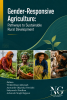
Gender-Responsive Agriculture: Pathways to Sustainable Rural Development

Authors

Dr. Venkteshwar Jallaraph (ed)
Indira Gandhi Agricultural University image/svg+xml
Dr. Ayotunde Olayinka Owolabi (ed)
Amsterdam University of Applied Sciences image/svg+xml
Dr. Sabyasachi Pradhan (ed)
Siksha O Anusandhan University image/svg+xml
Dr. Ashutosh Singh Rajpoot (ed)
School of Studies in Agricultural Sciences, Samrat Vikramaditya Vishwavidyalaya, Ujjain, M.P., India

Synopsis

Gender-Responsive Agriculture: Pathways to Sustainable Rural Development explores how gender equity can strengthen agricultural productivity, livelihood security, climate resilience, and inclusive rural transformation. The book recognizes women as farmers, entrepreneurs, knowledge holders, and decision-makers whose contributions to agriculture, livestock, nutrition, post-harvest management, and rural enterprises are essential but often undervalued.

It addresses gender-sensitive extension, access to land, credit, technologies, markets, digital tools, climate-smart agriculture, women-led enterprises, Farmer Producer Organizations, and policy support. Combining academic perspectives with field-based insights, the book offers practical pathways for integrating gender concerns into agricultural research, development programmes, institutions, and value chains.

The book is useful for students, researchers, teachers, extension professionals, policymakers, development practitioners, and organizations working towards equitable and sustainable rural development.

Chapters

Author Biographies

Dr. Venkteshwar Jallaraph, Indira Gandhi Agricultural University

Dr. Venkteshwar Jallaraph is a Subject Matter Specialist (Agricultural Extension) at Krishi Vigyan Kendra, Jagdalpur, under Indira Gandhi Krishi Vishwavidyalaya, Raipur. He holds a Ph.D. in Agricultural Extension Education, with academic qualifications from IGKV Raipur, RVSKVV Gwalior, and JNKVV Jabalpur. He has professional experience in research, teaching, and agricultural extension administration, including roles as SRF-NEMA at ICAR-ATARI, Jabalpur; Guest Teacher at RVSKVV, Gwalior; and State Coordinator (ATMA) at the Directorate of Farmer Welfare and Agriculture Development, Bhopal. His work focuses on On-Farm Trials, Front Line Demonstrations, farmer training, rural youth capacity building, and research–extension linkages. His research interests include climate-change perception, livelihood security, FPO managerial competency, agricultural innovation adoption, ICT-enabled extension, and digital agriculture.

Dr. Ayotunde Olayinka Owolabi, Amsterdam University of Applied Sciences

Dr. Ayotunde Olayinka Owolabi is a Lecturer in Agricultural Extension & Transfer Technologies at Digital Society School, Amsterdam University of Applied Sciences, Amsterdam. She holds a PhD and is an emerging scholar in agricultural extension, rural development, agricultural economics, sustainable development, and community-based innovation. Her academic work focuses on strengthening agricultural advisory services, improving farmers’ access to technologies and information, and promoting resilient rural livelihoods. Her research portfolio includes studies on climate-smart agriculture, extension agents’ competency and training needs, ICT use in agricultural extension delivery, food security, rural women’s nutrition education, farmer training, and adoption of improved agricultural technologies. She is also involved in research on factors influencing the adoption of orange-fleshed sweet potato varieties among farmers in Kwara State, Nigeria. Dr. Owolabi has contributed to more than 30 scholarly publications and her work reflects a strong commitment to practical, evidence-based solutions for improving agricultural productivity, digital extension systems, food security, and sustainable rural development in Nigeria and Netherlands and other developing-country contexts.

Dr. Sabyasachi Pradhan, Siksha O Anusandhan University

Dr. Sabyasachi Pradhan is an Assistant Professor in the Department of Agricultural Extension and Communication, Faculty of Agricultural Sciences, Siksha 'O' Anusandhan (Deemed to be University), Bhubaneswar, Odisha. He obtained his Ph.D. in Agricultural Extension and Communication from Jawaharlal Nehru Krishi Vishwa Vidyalaya (JNKVV), Jabalpur, Madhya Pradesh. He has qualified both the ICAR-National Eligibility Test (ICAR-NET) and the University Grants Commission-National Eligibility Test (UGC-NET). He serves as the Co-Principal Investigator (Co-PI) of an ICSSR-funded research project on “Impact Assessment of Mo Upakari Bagicha on Women: A Study in Southern Districts of Odisha” His research interests include agricultural extension, nutrition-sensitive agriculture, sustainable livelihoods, ICT-enabled extension, artificial intelligence, and data analytics in agriculture. Dr. Pradhan has published several research papers in reputed peer-reviewed journals, authored book chapters, and holds patents related to AI-enabled agricultural technologies. He actively contributes to teaching, research, capacity building, and academic administration, while serving as a reviewer and editorial board member for scholarly journals and as a life member of leading professional societies in agricultural extension.

Dr. Ashutosh Singh Rajpoot, School of Studies in Agricultural Sciences, Samrat Vikramaditya Vishwavidyalaya, Ujjain, M.P., India

Dr. Ashutosh Singh Rajpoot is presently serving as faculty in the discipline of Agricultural Extension Education at School of Studies in Agricultural Sciences, Samrat Vikramaditya Vishwavidyalaya, Ujjain, M.P., India. He completed his undergraduate degree from AKS University Satna, his postgraduate degree from Rajmata Vijayaraje Scindia Krishi Vishwa Vidyalaya, Gwalior M.P. and doctoral degree was from Jawaharlal Nehru Krishi Vishwavidyalaya, Jabalpur, M.P. and also qualify ICAR-ASRB National Eligibility Test. Dr. He is actively engaged in teaching, research, and extension activities, involved in guiding undergraduate students, coordinating academic programs such as RAWE (Rural Agricultural Work Experience), and contributing to capacity-building initiatives for farmers and rural youth. He has published several research papers, book chapters, and technical articles in reputed national and international journals and has presented his work in various seminars, conferences, and workshops. He has also participated in several national training programs and academic development initiatives and is associated with professional societies in the field of agricultural extension. He continues to contribute towards strengthening the linkage between research, education, and field-level agricultural development.

gra cover

Published

June 30, 2026

Details about the available publication format: Book

Book

ISBN-13 (15)

978-81-996718-3-6

Details about the available publication format: E-book reader

E-book reader

ISBN-13 (15)

978-81-996718-9-8

How to Cite

Jallaraph, V., Owolabi, A. O., Pradhan, S., & Rajpoot, A. S. (Eds.). (2026). Gender-Responsive Agriculture: Pathways to Sustainable Rural Development. Next Gen Academic Services Private Limited. https://ngenbook.com/index.php/ng/catalog/book/gra