
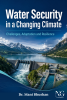
Water Security in a Changing Climate: Challenges, Adaptation, and Resilience
Synopsis
Water security is one of the most pressing challenges of the present century. Climate change is altering rainfall patterns, intensifying floods and droughts, affecting groundwater recharge, degrading water quality, and increasing pressure on freshwater resources. These changes make water security not only a question of water availability, but also of reliability, accessibility, equity, ecosystem health, institutional capacity, and long-term resilience.
This authored book, Water Security in a Changing Climate: Challenges, Adaptation, and Resilience, presents an integrated understanding of water security in the context of climate change. The book begins with the basic concept of water security and the changing global water cycle, and then discusses impacts on surface water, groundwater, extreme events, and water quality. It further examines agricultural water management, urban water security, ecosystem health, wetlands, environmental flows, community-based adaptation, technological innovations, integrated watershed management, water governance, livelihood concerns, and future pathways for resilient water systems.
The author has attempted to present the subject in a clear, systematic, and applied manner so that readers can connect scientific understanding with practical adaptation measures. The book highlights that technical solutions alone cannot ensure water security unless they are supported by effective governance, inclusive policies, community participation, nature-based solutions, climate-resilient infrastructure, and responsible water use. Special attention is also given to the social dimensions of water insecurity, as climate-related water risks often affect vulnerable communities, smallholder farmers, women, and livelihood-dependent populations more severely.
This book is intended for students, researchers, teachers, policymakers, development professionals, extension workers, environmental planners, and water resource managers. The chapters are structured to help readers move from conceptual understanding to sector-specific challenges and finally toward integrated solutions.
The author believes that strengthening water security in a changing climate requires informed planning, interdisciplinary knowledge, participatory governance, and collective responsibility. This book is a modest contribution toward promoting sustainable and resilient water futures.
Published
July 18, 2026
Copyright (c) 2026 Next Gen Academic Services Private Limited
Details about the available publication format: Book
Book
ISBN-13 (15)
978-81-686718-8-1
Physical Dimensions
Details about the available publication format: E-book reader
E-book reader
ISBN-13 (15)
978-81-686718-7-4
Details about the available publication format: View
View
ISBN-13 (15)
978-81-686718-8-1
How to Cite
Bhushan, M. (2026). Water Security in a Changing Climate: Challenges, Adaptation, and Resilience. Next Gen Academic Services Private Limited. https://ngenbook.com/index.php/ng/catalog/book/wscc